
Were Unicity Reviews Incentivised? Questions Behind Feel Great’s Trustpilot Rating
Unicity’s Feel Great products have attracted overwhelmingly positive reviews on Trustpilot. But information provided to Unicity Reviews raises an important question: were some people encouraged to leave reviews in return for account credit?
Online reviews matter.
For someone considering spending a significant amount of money on a health and wellness product, reviews can provide reassurance that the experiences shown in advertising are reflected by ordinary customers.
That makes the independence of those reviews particularly important.
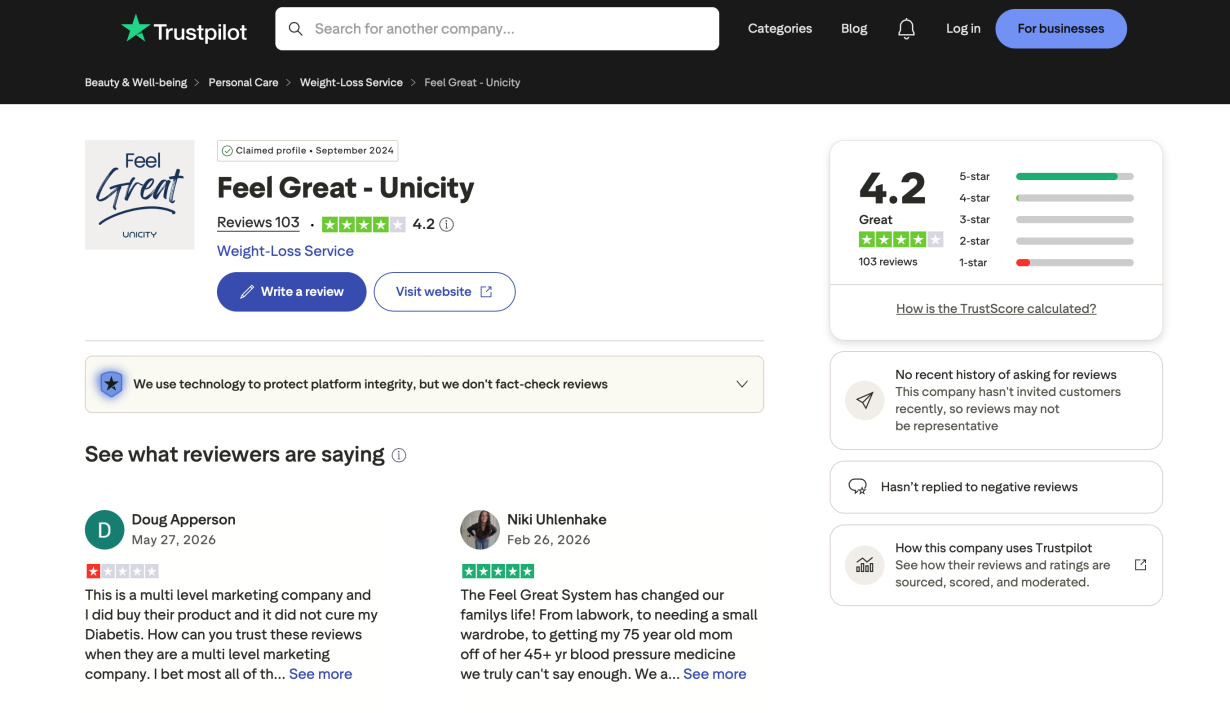
At the time of writing, the Trustpilot profile for Feel Great – Unicity displays a TrustScore of 4.2 out of 5 from 103 reviews. Trustpilot reports that 86% are five-star reviews, while 12% are one-star.
There is nothing inherently suspicious about receiving overwhelmingly positive reviews. A good product can produce happy customers, and we have no reason to assume that the positive experiences described by individual reviewers are false.
However, information supplied to Unicity Reviews raises questions about how at least some reviews may have been generated.
What we have been told
Unicity Reviews has received information from a creadble source concerning an alleged campaign in which people associated with Unicity were awarded product/account credit in connection with leaving online feedback or reviews.
The source has also supplied a information containing names of customers and partners who, according to the source, received credits during the relevant campaign.
We have deliberately not published the spreadsheet or identified the individuals contained within it.
These are significant allegations, and they need to be treated accordingly.
At this stage, we are not claiming that every person listed received credit specifically for posting a Trustpilot review, nor are we claiming that Unicity’s entire Trustpilot profile consists of incentivised reviews.
Those conclusions would go beyond the evidence currently available to us.
The source has indicated that additional corrispondance relating to the campaign may still be available for us to publish. We are seeking those records and will update this article if further evidence can be verified.
Why an incentive would matter
The issue isn’t simply whether somebody was paid £10, £20 or another amount.
It’s whether anything of value was offered in connection with leaving a review.
Trustpilot’s current rules are very clear on this point. Its reviewer guidelines state that incentivised reviews are not permitted and specifically include discounts, promotional codes, refunds, freebies or any other benefit connected to the business for leaving a review.
Trustpilot’s rules for businesses similarly say that companies may invite customers to review them, but invitations must be fair, neutral and unbiased, with no incentives offered.
Trustpilot itself explains the principle simply: businesses may ask customers for reviews, but they cannot offer payment or incentives for doing so.
Product credit would therefore be highly relevant if documentary evidence establishes that it was awarded in exchange for, or conditional upon, leaving a Trustpilot review.
There’s another issue: who is leaving the reviews?
This question becomes particularly important in a direct-selling business.
Unicity does not operate solely through conventional retail customers. Its business model also involves independent distributors who can have a financial interest in selling Unicity products and building their organisations.
That doesn’t mean a distributor cannot genuinely love a product.
Many undoubtedly do.
But there is an important distinction between an independent customer’s recommendation and an endorsement from someone who may also have a commercial relationship with the company or its products.
Indeed, Trustpilot’s current reviewer rules state that a person isn’t eligible to review a business where they have a “special relationship” with it, including working with or for the business or being a shareholder.
Exactly how those provisions apply to particular independent distributors is ultimately a matter for Trustpilot to determine.
But from a consumer-transparency perspective, the underlying question is straightforward:
When you read a five-star review, do you know whether you’re reading the opinion of an ordinary retail customer or someone commercially involved in selling the product?
That distinction matters.
The unusual review activity deserves examination — not assumptions
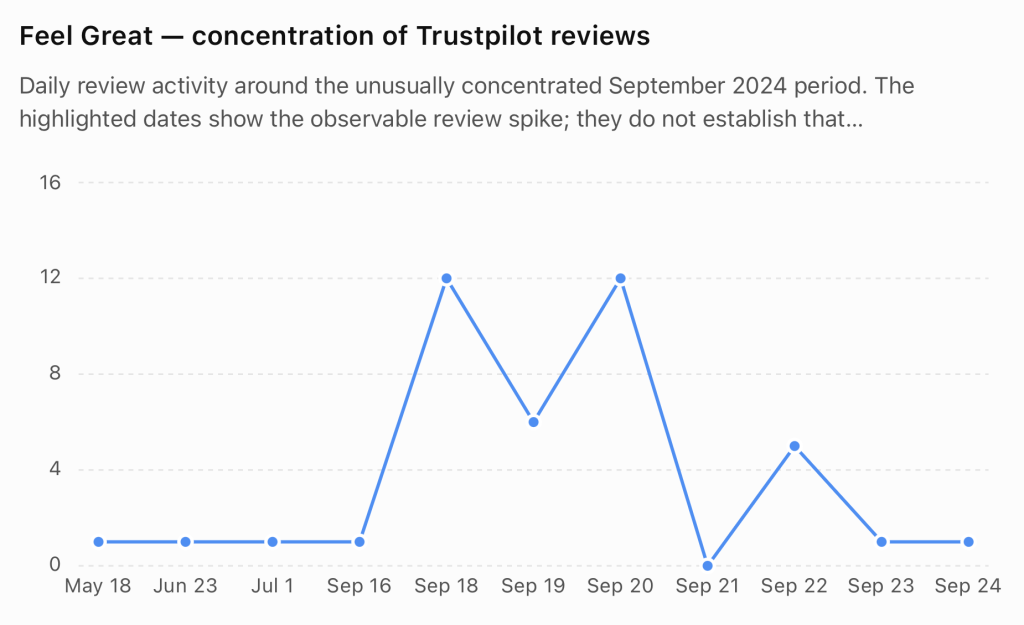
We have also examined the chronology of reviews appearing on the Feel Great Trustpilot profile.
Periods of concentrated review activity can be useful indicators when investigating whether a company has undertaken a review-generation campaign.
A company might send a perfectly legitimate email asking all customers for honest feedback, launch a new product, increase its customer base, or simply begin actively using Trustpilot.
For that reason, we do not regard clusters of reviews as proof that those reviews were incentivised.
They become more significant only when considered alongside documentary records, communications, account credits and testimony from people involved in the campaign.
That is the evidence we are continuing to investigate.
Positive reviews can still represent genuine experiences
This point is important.
Even if it were ultimately established that some reviewers received an incentive, that would not automatically mean their experiences were fabricated.
A customer could genuinely love Feel Great and still have received credit for posting their opinion.
Those are two separate questions.
The problem with incentivisation is that it potentially changes the selection of people who choose to review and therefore what a prospective customer believes the overall review score represents.
Consumers generally expect a Trustpilot score to emerge from independent experiences rather than a company-sponsored review drive carrying a financial or product benefit.
That’s precisely why Trustpilot prohibits incentives.
Some of the reviews raise separate health-claim questions
There is another aspect of the current profile worth examining separately.
Trustpilot currently displays, among its highlighted reviews, a February 2026 five-star review describing a family member coming off long-term blood-pressure medication. Other visible reviews contain claims concerning inflammation, gut symptoms and other health outcomes.
We are not saying Unicity wrote those statements, nor does their presence establish that Unicity instructed customers or distributors to make them.
They are statements made by individual reviewers.
However, because Feel Great is marketed within the health and wellness sector, we believe there is legitimate public interest in examining how product testimonials, distributor marketing and medical claims interact.
That will be the subject of a separate investigation.
What would resolve this?
This is precisely the sort of issue where transparency benefits everyone.
We would welcome clarification from Unicity addressing whether it has ever:
- offered product or account credit for submitting reviews or feedback;
- run campaigns encouraging distributors or customers to post reviews on Trustpilot;
- required evidence that a review had been posted before awarding credit;
- distinguished between retail customers and distributors when requesting reviews; and
- informed Trustpilot of any campaigns involving incentives.
If the credits identified in the material supplied to us were unrelated to Trustpilot reviews, we would equally welcome documentation establishing that.
We will publish any substantive response prominently and fairly.
Our position
Unicity Reviews is not being created on the assumption that everything Unicity does is wrong.
Quite the opposite.
There are customers who report genuinely positive experiences with Unicity products, and those experiences deserve to be represented here alongside criticism.
But transparency has to work both ways.
If consumers are being influenced by a public review score, they deserve to understand how those reviews were obtained, whether reviewers had commercial relationships with the company, and whether incentives played any role in generating them.
At present, we have information that raises legitimate questions.
We do not yet have sufficient evidence to present every allegation as established fact.
So we won’t.
We will continue obtaining documents, analysing the available review data and giving Unicity an opportunity to respond.
If the evidence ultimately disproves the allegation, we will say so.
If it substantiates it, we will publish that too.
Because the purpose of Unicity Reviews isn’t to tell consumers what to think.
It’s to give them information they might not otherwise see — and let them decide for themselves.