
Unicity paid $200,000 following a California Proposition 65 case involving lead in dietary supplements. It sounds alarming — but the 0.5 microgram warning threshold, the nature of the case and dozens of similar supplement actions provide important context that consumers rarely hear.
There are legitimate reasons to scrutinise a health and wellness company. Consumers should expect supplements to meet applicable safety and labelling standards, and Unicity should not receive a free pass when it fails to comply with them.
But scrutiny should work both ways.
When a regulatory or court case is used to suggest that consumers were exposed to dangerous products, the details matter.
The California lead case involving Unicity is a good example.
What actually happened?
In August 2014, Environmental Research Center, Inc. (ERC) filed a Proposition 65 notice concerning a number of Unicity dietary supplements.
The chemical identified was lead and lead compounds.
A civil complaint followed in May 2015 in Alameda County Superior Court. According to California’s official Proposition 65 database, the plaintiff was Environmental Research Center, Inc., and the type of claim was:
“Failure to Warn.”
The relief sought included a warning and civil penalties.
This distinction is important.
This was not a case in which California health authorities announced that consumers had suffered lead poisoning from Unicity products.
Nor does the official case record describe a finding that Unicity deliberately added lead to its products.
Instead, it was an enforcement action under California Proposition 65, alleging exposure to lead without the warning required by that particular California law.
Unicity ultimately settled.
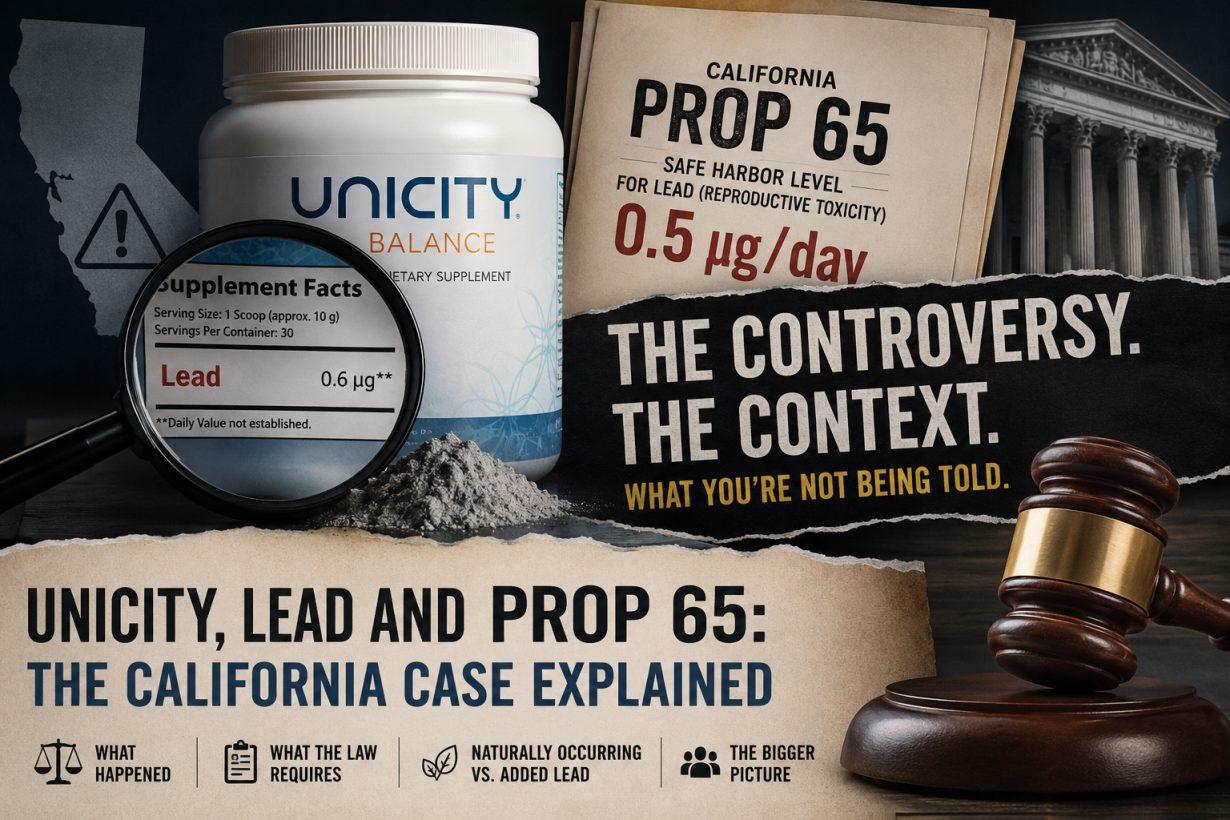
The settlement involved a $96,900 civil penalty, $29,133 in attorneys’ fees and costs, and $73,967 as a payment in lieu of penalties, for total payments of $200,000.
Unicity also agreed to measures involving ceasing sales of certain products, warnings and/or reformulation, and testing. The judgment was entered in July 2015.
Those facts shouldn’t be minimised.
Unicity was subject to the California law, a case was brought, and the company settled it.
But understanding what Proposition 65 actually requires significantly changes how those facts should be interpreted.
The number that changes the context: 0.5 micrograms
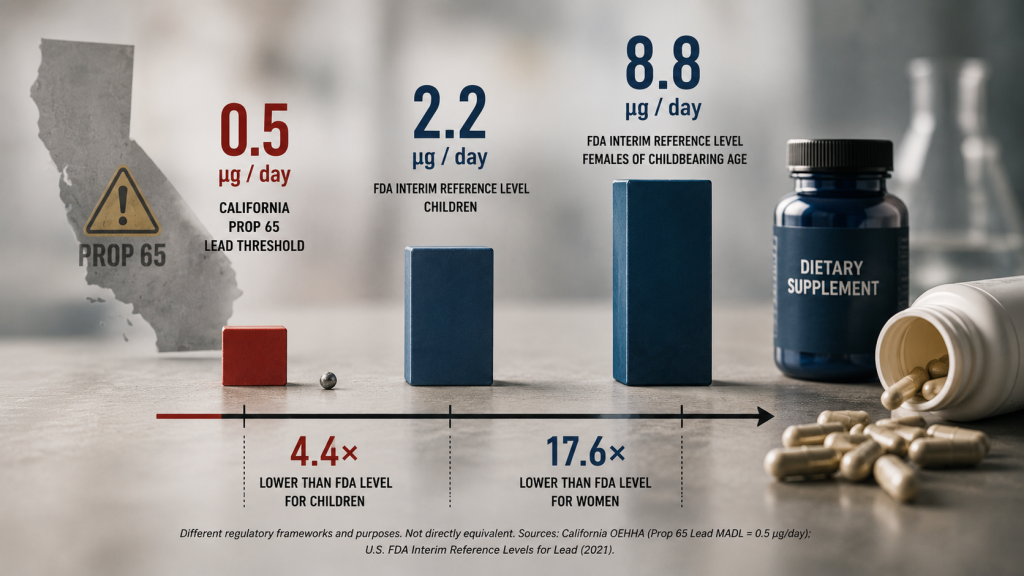
Proposition 65 has an exceptionally conservative lead threshold.
In dietary-supplement settlements, a figure that repeatedly appears is:
0.5 micrograms of lead per day
That is half of one millionth of a gram.
Numerous California Proposition 65 settlements involving supplements specify that products exposing a consumer to more than 0.5 µg of lead per day must carry the appropriate warning unless another provision or exemption applies.
And this wasn’t something created specifically for Unicity.
For example, Environmental Research Center subsequently pursued PureBulk over dietary supplements containing lead. Its 2021 settlement applied the same 0.5 µg/day threshold.
A settlement involving BRL Sports Nutrition did the same.
So did proceedings involving WTHN.
And more than a decade after the Unicity case, the same type of enforcement continues. A 2026 judgment involving Alpha Prime Supplements again uses 0.5 µg/day as the relevant daily lead exposure level for warning purposes.
That wider context is important because it demonstrates that Unicity wasn’t singled out under some extraordinary finding unique to its manufacturing.
It was one company among many operating in a category that has repeatedly encountered Proposition 65 lead litigation.
Does exceeding 0.5 µg mean a supplement is dangerous?
No — not by itself.
And this is probably the most important point for consumers reading about the Unicity case.
A Proposition 65 safe-harbour threshold should not be interpreted as a dividing line where:
0.49 µg = safe
and
0.51 µg = dangerous
That isn’t what it means.
For some useful contemporary context, the US Food and Drug Administration currently uses an Interim Reference Level (IRL) for dietary lead exposure.
The FDA says that no safe level of lead exposure has been identified, so reducing exposure is important. However, its current reference levels are:
Children: 2.2 µg/day
Females of childbearing age: 8.8 µg/day
Importantly, the FDA says these reference levels themselves incorporate a 10-fold safety factor.
That means California’s 0.5 µg/day Proposition 65 threshold is approximately:
4.4 times lower than the FDA’s current reference level for children.
And:
17.6 times lower than the FDA’s current reference level for females of childbearing age.
These aren’t directly interchangeable regulatory standards, and they shouldn’t be presented as though they are. The FDA and Proposition 65 frameworks have different purposes.
But the comparison illustrates something extremely important:
Crossing California’s Proposition 65 warning threshold does not, on its own, establish that a product contained a level of lead considered dangerous by federal food-safety authorities.
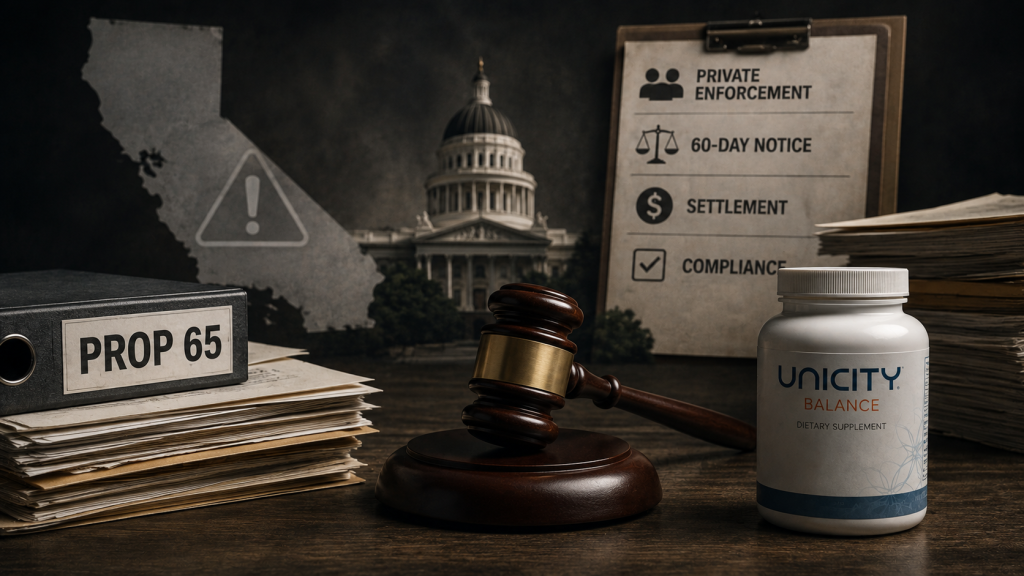
That distinction can disappear very quickly when the Unicity case is reduced to a social-media post.
But why would lead be in a supplement at all?
The word lead understandably alarms people.
What is less commonly understood is that lead is an environmental contaminant.
It can occur in soil, water and consequently foods and agricultural ingredients.
The FDA explains that lead can enter the food supply because it is present in the environment, including from both natural geological processes and human activity. The agency therefore works to reduce dietary exposure rather than operating on the assumption that every detectable trace establishes unsafe contamination.
This distinction can become particularly relevant to supplements containing substantial amounts of botanical, mineral or other naturally derived ingredients.
It doesn’t mean manufacturers should ignore lead.
Quite the opposite: responsible manufacturers should test ingredients and finished products and minimise exposure wherever reasonably possible.
But:
“Lead was detected”
and
“This product contained a dangerous amount of lead”
are two very different scientific statements.
Unicity was not alone
This is perhaps the most revealing context surrounding the case.
Search California’s Proposition 65 enforcement records and Unicity quickly stops looking like an isolated example.
Environmental Research Center has repeatedly brought lead-related Proposition 65 actions against businesses selling dietary supplements.
A 2013 case against Robbins Research International concerned lead in dietary supplements and resulted in an $85,000 settlement. Products exposing consumers to more than 0.5 µg/day required warnings under that agreement.
ERC subsequently brought cases involving businesses including PureBulk, BRL Sports Nutrition, Equilibrium Nutrition, Dr. Berg Nutritionals and numerous others.
The pattern continues today.
California records show a 2024 ERC dietary-supplement case against Alete Active Nutrition involving lead, again resulting in a settlement structured around the 0.5 µg/day threshold.
As recently as 2026, California’s database records another settlement involving dietary supplements and the same threshold.
This doesn’t prove that Unicity’s compliance failure was acceptable.
It demonstrates something different:
The Unicity case was part of a much broader pattern of Proposition 65 enforcement against the supplement industry.
That’s valuable context if someone presents the case as evidence of some extraordinary or uniquely reckless practice by Unicity.
Another important distinction: who brought the case?
It is easy to come away from references to the “California lead case” believing California’s food or health regulator investigated Unicity and prosecuted it for selling unsafe supplements.
That’s not what the official record says.
The noticing party and plaintiff was:
Environmental Research Center, Inc.
California’s database identifies ERC as the party bringing the action and Unicity as the defendant.
ERC is also the plaintiff appearing repeatedly in the other supplement cases discussed above.
This is possible because Proposition 65 permits private enforcement.
Again, this does not make the action illegitimate.
Private enforcement is an intentional part of California’s regulatory system and can identify violations that government agencies might otherwise never pursue.
But it’s still an important fact for consumers to know.
Saying:
“Unicity was sued under California Proposition 65 by a private enforcement organisation”
provides considerably more information than:
“California prosecuted Unicity for lead in its products.”
The latter risks giving readers the wrong impression about what actually occurred.
So was Unicity in the wrong?
On compliance, there is no reason for us to give Unicity a pass.
A Proposition 65 action was brought. Unicity chose to settle it. It paid substantial sums and agreed to compliance measures involving products, warnings, testing and/or reformulation.
Consumers are entitled to know that.
If a company sells into California, it is responsible for understanding and complying with California law — however demanding that law may be.
But there is an equally important second question:
What does the case tell us about the safety of Unicity products?
Here the answer is considerably less dramatic.
The official record establishes a Proposition 65 failure-to-warn case.
It does not, by itself, establish that consumers were poisoned.
It does not establish that Unicity deliberately added lead to its products.
And the existence of a Prop 65 lead case does not mean that a product exceeded every other American health or food-safety benchmark.
Those distinctions matter.
Why the case can sound much worse online
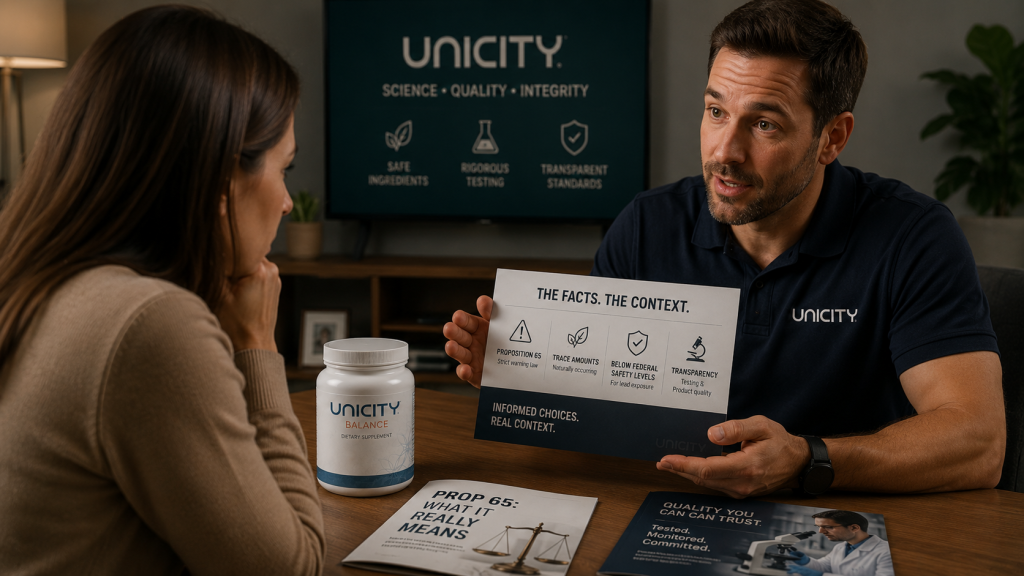
UNICITY PAID $200,000 AFTER LEAD WAS FOUND IN ITS SUPPLEMENTS
Every individual component can be arranged around facts contained in the case history.
But a consumer reading it could reasonably conclude:
Dangerously contaminated supplements were discovered, authorities intervened, and Unicity was fined $200,000 for putting consumers at risk.
That isn’t what the official record actually establishes.
Now consider this description:
In 2015, Unicity paid $200,000 in a settlement arising from a privately brought California Proposition 65 failure-to-warn case concerning lead exposure from certain dietary supplements. The settlement included penalties, legal costs and other payments, and required product-related compliance measures. Similar Prop 65 lead cases have been brought against numerous other supplement companies.
Less sensational.
But considerably more informative.
And that is precisely why context matters.
Proposition 65 itself is unusually strict
None of this means Proposition 65 is a bad law.
There is a perfectly reasonable philosophy behind it.
California decided consumers should receive warnings about exposure to chemicals associated with cancer, reproductive harm or birth defects, using deliberately cautious thresholds.
Supporters can reasonably argue that businesses — rather than consumers — should carry the burden of knowing what’s in their products.
But an unintended consequence of such conservative thresholds is that consumers can easily misunderstand what a warning or enforcement action signifies.
A chemical can exist at a very small level and still create a Proposition 65 issue.
That’s particularly relevant when discussing naturally derived food and supplement ingredients.
The existence of an enforcement action therefore needs to be separated from the question consumers usually care about most:
“Was this product actually dangerous to me?”
They aren’t necessarily the same question.
What we think the evidence supports
After reviewing California’s records and comparing the Unicity case with other supplement enforcement actions, our assessment is fairly straightforward.
Unicity should have complied with the applicable California requirements.
We’re not going to excuse that.
But we also don’t believe the evidence supports using this case, without further context, to frighten consumers into believing that California discovered Unicity selling dangerously lead-contaminated supplements.
The case was specifically recorded as a failure-to-warn Proposition 65 claim.
The relevant California lead threshold is extraordinarily conservative compared with current FDA dietary lead reference levels.
And Unicity was far from alone in facing this type of litigation. California’s own records document numerous similar cases against other dietary-supplement businesses, including cases brought by the same organisation.
That doesn’t erase Unicity’s settlement.
It puts it in context.
Our conclusion
There will be occasions on this site when our investigation of an issue reflects poorly on Unicity.
This isn’t one of the stronger examples.
The company faced a genuine compliance issue and paid a substantial settlement. That deserves to remain part of the public record.
But consumers deserve the rest of the story too.
A Proposition 65 warning threshold is not synonymous with a poisoning threshold.
Detection of trace lead is not synonymous with dangerous lead contamination.
And Unicity’s case was not an isolated event in the dietary-supplement industry.
Criticism of a company is legitimate.
Leaving out information that materially changes what consumers are likely to understand from that criticism isn’t.
At Unicity Reviews, we’ll apply the same standard whether the evidence favours Unicity or works against it:
show the evidence, provide the context, and let consumers decide.